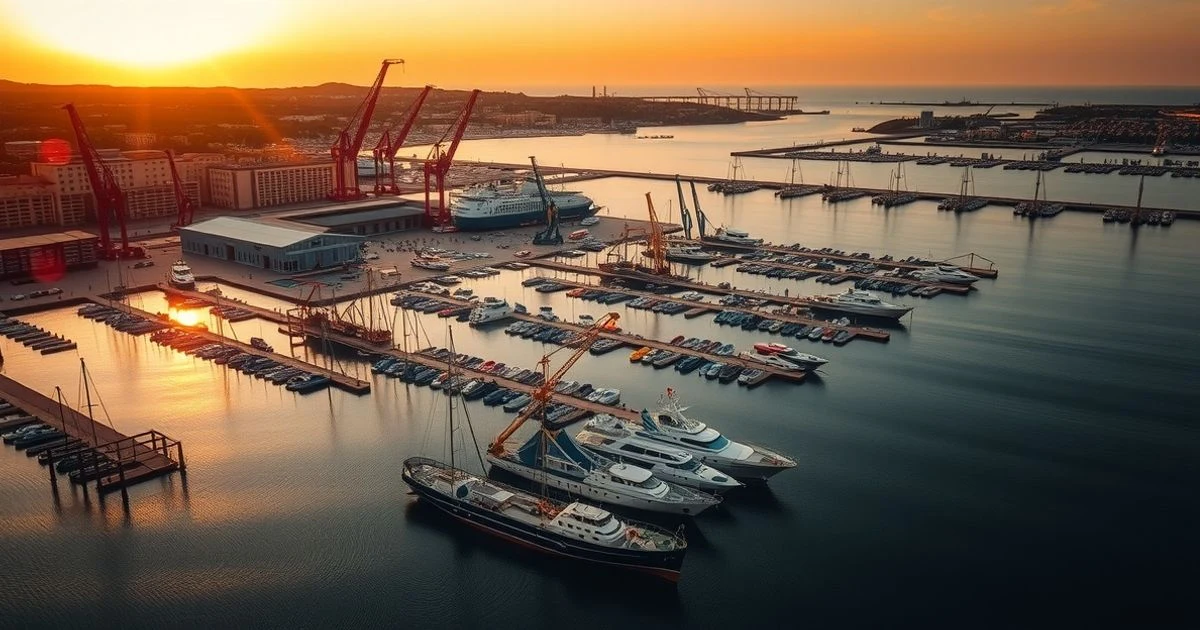
The Port Authority of the Balearic Islands has selected five multidisciplinary teams to develop the preliminary projects for the Master Plan for port-city integration. The proposals will be revealed in November.
The Port Authority of the Balearic Islands (APB) has taken a decisive step towards the transformation of the port of Palma. Five internationally renowned multidisciplinary teams will compete to design the future of the main port of the Balearic Islands. The selected teams are UTE Typsa Zha BBARQ, UTE Arup Bir Junquera, UTE Sener West 8 Project L35 Etipsa, IDOM, and UTE Bau Mangado-Goc Proyecto.
These candidates comprise companies with experience in landmark projects in cities such as Rome, New York, Amsterdam, and Barcelona. They will now have four months to develop a technical and economic preliminary project that defines the transformation of the port area.
An internationally significant competition
The selection process has generated notable interest in the sector. Thirteen applications expressed interest in the project, comprising 41 companies from Spain, the United Kingdom, Denmark, the Netherlands, and the United States, with over 250 specialised professionals. The APB has assessed the technical, economic, and financial solvency of all applicants to choose the five best-rated teams.
The selected teams must provide a comprehensive vision of the port, addressing challenges such as mobility, sustainability, urban integration, landscape quality, and coexistence between port activities and new spaces for citizens. The goal is to have the five preliminary projects ready by November.
An expert committee will decide the winning proposal
In November, an independent expert committee will analyse the proposals. This body will include representatives from the APB, the Palma City Council, the Government, the Mallorca Council, State Ports, the Official College of Architects of the Balearic Islands, the College of Civil Engineers, Canals and Ports, and an international expert from the Association Internationale Villes et Ports (AIVP).
The evaluation will be rigorous and objective, based solely on technical criteria. The winning proposal will be announced before the end of the year and will serve as the basis for drafting the definitive Master Plan. This document will establish the roadmap for the comprehensive transformation of the port of Palma.
Redefining the relationship between the port and the city
The Master Plan is the main initiative of the APB to redefine the relationship between the port and Palma. The document will set out guidelines for reorganising nearly 400,000 square metres of the port area. The aim is to enhance logistical competitiveness and the nautical industry while creating new spaces for culture, education, sports, innovation, heritage, and leisure.
The project is the result of an extensive participatory process involving more than sixty economic, social, and institutional stakeholders. It aims to consolidate a model of a more efficient, sustainable, and integrated port with the city, transforming Palma's waterfront into a reference space for citizens and for the economic development of the Balearic Islands.
For the residents of Palma, this means that in the coming years, the port will cease to be a barrier and will become a meeting place. The new spaces will allow enjoyment of the sea without sacrificing port activities. The transformation will affect areas such as Moll Vell or the West Dock, where cultural and leisure uses are anticipated.
The timeline anticipates that the master plan will be ready by 2027, with construction possibly starting in 2028. In the meantime, citizens will be able to follow the process through the participation channels established by the APB. The next event will be in November when the five preliminary projects are presented. Until then, we must wait and dream of a more human port.

You may also like


