The Ministry of Business, Self-Employed and Energy has contracted to measure polycyclic aromatic hydrocarbons (PAHs) in the valley. The campaign will take place in autumn with the Government's Mobile Air Quality Unit.
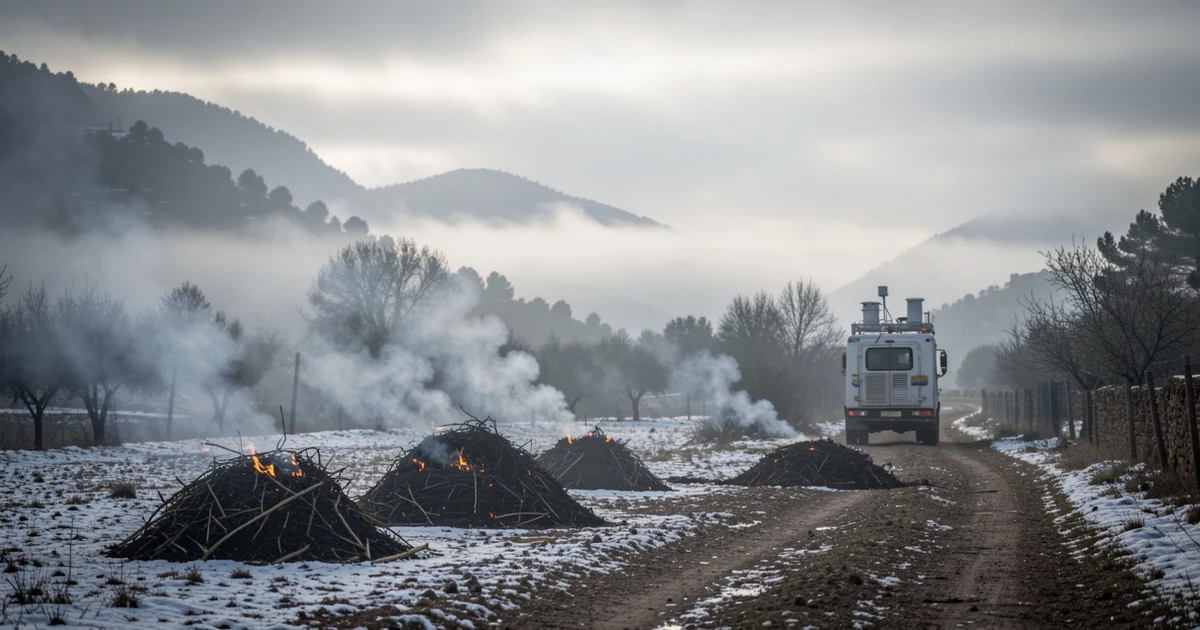
The Balearic Government wants to clarify doubts. The Ministry of Business, Self-Employed and Energy has contracted to analyse whether the burning of pruning waste has a direct impact on the pollution episodes suffered by the Sóller valley. The focus of the study is on polycyclic aromatic hydrocarbons (PAHs), compounds that appear when organic matter is burned and can be harmful to health.
The measurement campaign will start next autumn. The Government's Mobile Air Quality Unit will be set up at various points in the municipality to collect data. The novelty is that, for the first time, PAHs will be specifically analysed, something for which the regional administration acknowledges it does not have the necessary equipment. Therefore, it has outsourced the service.
28 samples over 24 hours to trace the source of pollution
The contracted service includes the collection of 28 air samples over 24 consecutive hours. PM10 particle filters will be used, which are the smallest and penetrate the lungs the most. Afterwards, an accredited laboratory will analyse substances such as benzo(a)pyrene and other PAHs regulated by state legislation. The results must be delivered to the Climate Change and Atmosphere Service within a maximum period of one month.
The aim is to determine whether agricultural burning significantly contributes to those specific pollution episodes concentrated in the valley. Especially in winter, when thermal inversions trap cold air and smoke remains stagnant as if under a lid. Residents suffer from this every year: around twenty days when breathing becomes more difficult.
A recurring debate now seeking scientific basis
This is not the first time agricultural burning has come under scrutiny. In 2022, then-mayor Carlos Simarro announced his intention to draft an ordinance to restrict burning during the early morning hours in winter. The measure sparked intense debate. Farmers, who have always burned pruning waste, argued that doing so early is traditional because the heat becomes intense later. In the end, the ordinance was never approved.
Now, the Government wants objective data. The idea is for science, not opinions, to guide the way. If it is confirmed that burning is a significant source of pollution, informed decisions can be made. And if it is not, that too. For the residents of Sóller, who have been demanding cleaner air for years, this study is a step forward. The Sóller per l’Aire platform has already reported that the town centre failed to meet the World Health Organization's recommendations in 2025, albeit only for about twenty days a year.
The results of the analysis are expected to be known by early 2027. Until then, burning will continue to be a common practice in the Sóller countryside, but under the watchful eye of the Government's sensors. Who knows if, in a few months, burning pruning waste at dawn will be a thing of the past.

You may also like