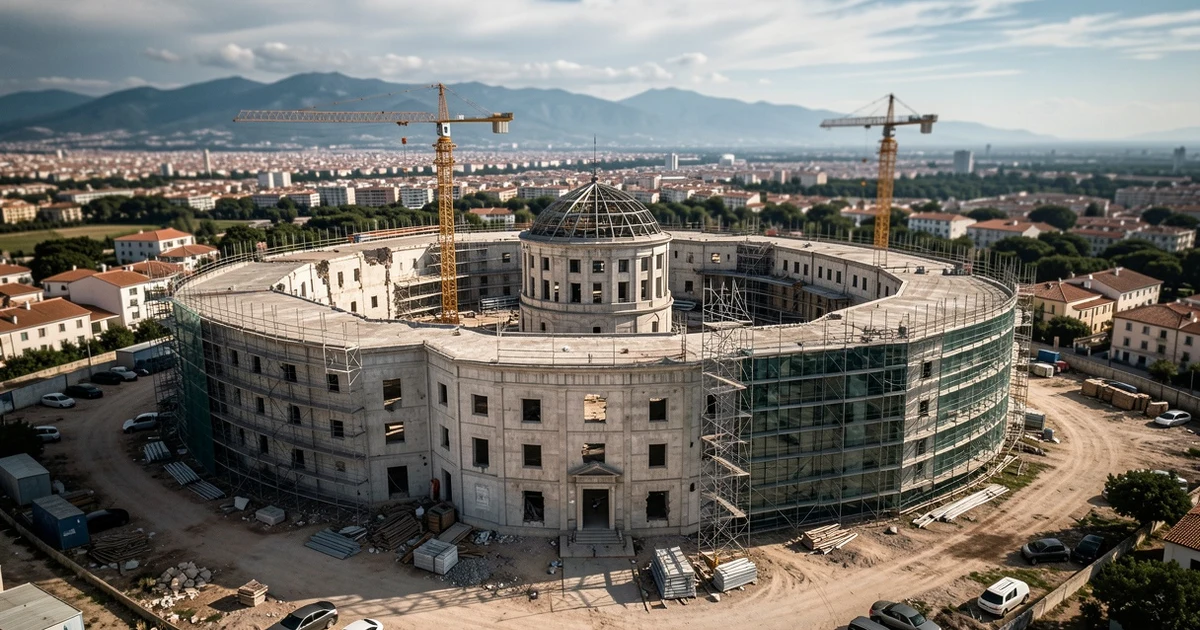
The Palma City Council plans to convert the old prison on the Sóller road, closed since 1999, into a complex of 139 temporary homes for doctors, civil servants, and other professionals who cannot afford the high cost of housing in Mallorca.
The old Francoist prison on the Sóller road, which housed common and political prisoners for decades, is preparing for a radical change of use. The Palma City Council presented this week the project to transform the building, closed in 1999, into a residential complex with 139 housing units intended for temporary rental. The renovation, which will demolish the outer walls but preserve the star-shaped panoptic structure, aims to address the difficulties many professionals face in finding affordable housing on the island.
A coliving space with shared services to attract talent
The new complex, conceived as a coliving space, will offer common areas such as a dining room, gym, swimming pool, and laundry. The homes, ranging from 16 to 40 square meters, will be rented for limited periods. The Mayor of Palma, Jaime Martínez, explained that the beneficiaries will be doctors, civil servants, researchers, university professors, and members of the security forces who often decline positions in Mallorca due to the high cost of housing.
The initiative aims to mitigate the brain drain the island suffers. According to data from the Consell, the average rent in Palma exceeds 1,200 euros per month, an unaffordable threshold for many professionals with average salaries. The project, still in the design phase, anticipates that the first keys could be handed over within three to four years, if urban planning and financing allow.
The challenges of converting a prison into a home
The transformation will not be straightforward. The building, constructed in 1955, is in a dilapidated state, with a deteriorated asbestos roof and heavy interior walls that will need to be adapted to current regulations. The architects in charge of the project will have to figure out how to convert a space designed for punishment into a welcoming place connected to the environment. The panoptic structure, which allowed total surveillance from a central point, will be preserved as a historical element but will be redistributed to create the homes.
This is not the first time an old prison has been converted into housing. In Rotterdam, a 19th-century prison was transformed in 2021 into a residential complex with prices starting from 200,000 euros. In Virginia (USA), the Lorton reform school was converted into rental apartments with shared services. And in the Bronx (New York), a juvenile detention center is being rehabilitated as affordable housing with commercial spaces. Palma is thus following a global trend that seeks to give new uses to obsolete infrastructures.
A breath of fresh air for the rental market in Palma
For the city's residents, the project represents a ray of hope amidst the housing crisis. The coliving of the old prison adds to other municipal initiatives, such as the promotion of public housing in Son Busquets or the regulation of tourist rentals. However, the City Council still needs to specify the allocation system for the homes and the prices, which will be lower than those of the free market.
The reconversion also carries special symbolism: moving from a space of confinement to one of emancipation. Meanwhile, technicians are working on feasibility studies and seeking funding, which could include European funds. The next public presentation of the project, scheduled for September, will detail the timelines and estimated budget. Those interested in these homes should keep an eye on the City Council announcements, although there is no date yet for the opening of applications.

You may also like


